For more than 260 million years, the turtle has roamed the Earth. In creation myths from various cultures, it carries the world on its back or embodies the Earth itself. At the same time, it is a vulnerable animal, threatened by climate change, pollution, and habitat loss. Precisely in an era characterized by constant acceleration, uncertainty, and a never-ending stream of stimuli, the turtle takes on new meaning.
With the question “What can we learn from the turtle?” the exhibition invites visitors to reflect on our relationship with time, attention, and the world around us. While our society often demands speed, efficiency, and constant availability, the turtle embodies a radically different attitude. Its slow pace, its ability to withdraw, and its deep connection to its surroundings offer space for reflection. What happens when we approach the world not with haste, but with attention? How do we relate to nature, history, and one another when we learn to slow down?
The exhibition brings together works by Allora (1974, Philadelphia, U.S.) & Calzadilla (1971, Havana, Cuba), Zoë Hollander ( 1987, Amsterdam), Studio Job (1969, Hamont-Achel, Belgium), Patricia Kaersenhout ( 1966, Den Helder), Anouk Kruithof (1981, Dordrecht), Nazif Lopulissa (1991, Tiel), Robin Meyer ( 1988, Amersfoort), Jacco Olivier (1972, Goes), Marjo Postma (1958, Ulestraten), and Jennifer Tee (1973, Arnhem). Their works address themes such as climate change, migration, identity, colonial history, and ecology.
The exhibition design was developed by Zoë Hollander. Highlights include a cinematic animation of a sea turtle swimming against the current, ceramic turtles that convey stories of migration and memory, and works in which the turtle takes on a second identity.
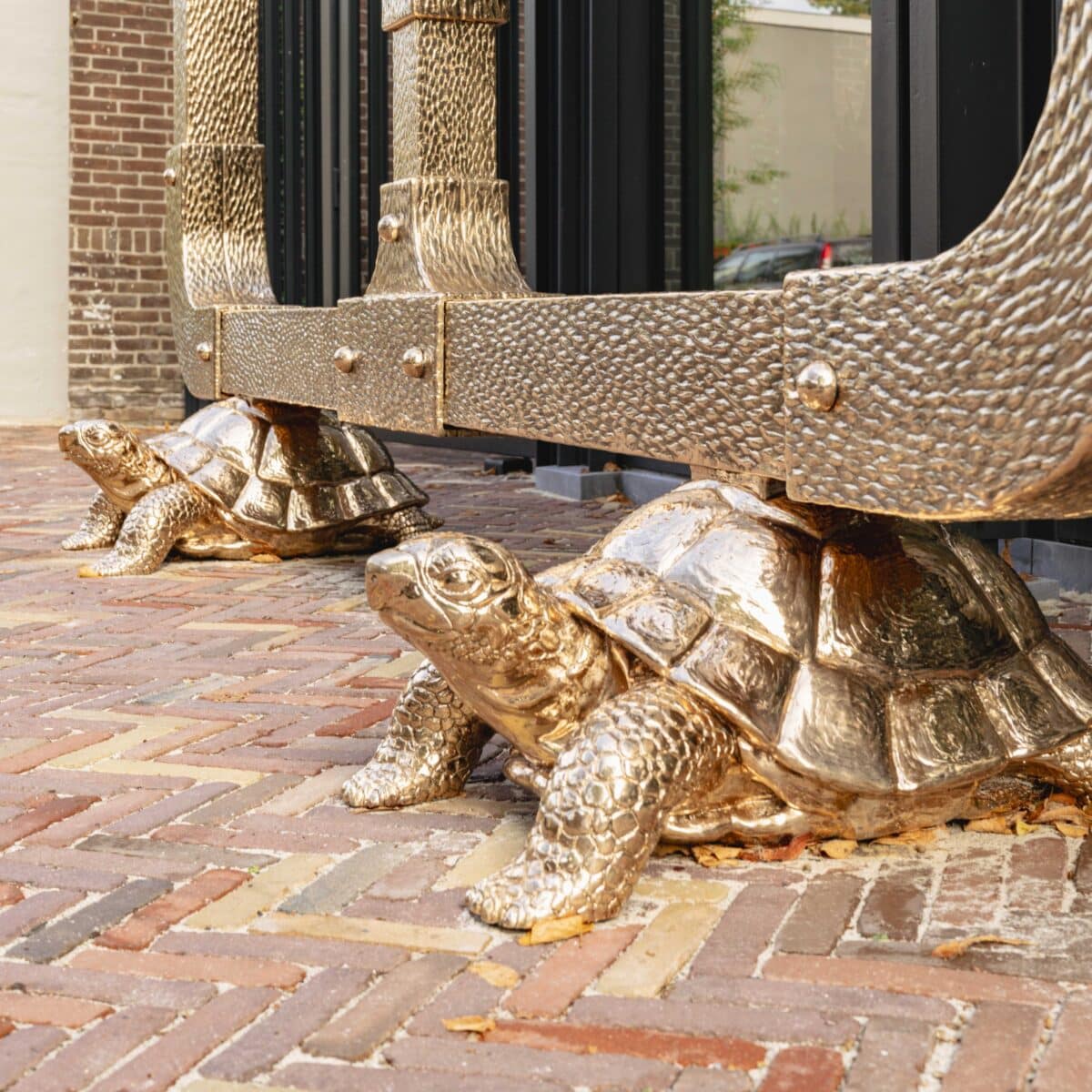
One notable detail is that the Kunstkerk itself also ties in with the exhibition’s theme. The building’s facade is adorned with *The Embrace* (2022) by Studio Job, a work of art in which four bronze turtles together form the foundation.